MISSION
We march for human life. For the unborn and the unseen. For those who are eagerly awaited and those who are at risk of never seeing the light of day. For mothers whose strength and care often go unnoticed. For fathers, whose support is especially important both for mothers and their children. For grandparents, whose wisdom, experiences and help are needed by every young family. For a society that respects human life and dignity from its beginning until natural death. For science that serves creation and life, not destruction.
Every life, no matter how small it may seem, is worthy of acceptance and accompaniment with love.
VISION
We want a society where a culture of life is deeply rooted. We seek a society where every mother is respected, supported, and shown compassion; where every father is encouraged to take responsibility and find pride in his fatherhood; and where life is valued for its inherent dignity.
We seek a society where every child is welcomed with gratitude as a gift, where spouses are encouraged to embrace parenthood, and where mothers and fathers are supported not only during pregnancy but also throughout the journey of raising their children.
GOALS AND OBJECTIVES
- Demonstrate peaceful yet firm support for human life and its inherent dignity, while strengthening the pro-life movement in Lithuania.
- Promote a culture of life, manifested through respect for unborn life, assistance to families facing crisis pregnancies and infertility, and financial support for raising children at the local, municipal, and national levels.
- Demonstrate that the defense of human life seeks the comprehensive support of both women and men, and not the opposite. Human life arises from the complementarity of the male and female sexes; therefore, it is impossible to defend it without recognizing the mutual contribution of the sexes and the shared responsibility of the father and mother for the creation and nurturing of new life.
- Encourage lawmakers to seek solutions grounded in concern for human life and dignity, rather than ideological motives, financial calculations, or consumerist logic.
- Demonstrate that the defense of human life is not merely a religious or political issue. It is the existential foundation upon which Western civilization rests.
CONTEXT
Every year, thousands of human lives are lost in Lithuania due to abortions. This is a tremendous loss not only for the mother and father, but for all of Lithuania. That life, which never saw the light of day due to the termination of pregnancy, could have been a talent for our country: a scientist, an inventor, an excellent doctor, or the father or mother of a large family. Unborn lives—these are thousands of hands that could have created and built a better Lithuania!
We see that Lithuania is experiencing a demographic winter. In such a situation, when our small nation faces extinction, every life matters. In this context, the Lithuanian Parliament’s aim to further encourage abortions by covering their costs from the Compulsory Health Insurance Fund appears controversial, regardless of whether the abortion is performed for objective medical reasons (when it is necessary to protect a woman’s health and life after serious fetal abnormalities have been detected) or for “family planning” purposes unrelated to health protection.
Children are the future of our homeland. The fact that fewer children are born in Lithuania than people die poses a threat to national security. Especially at this time, in the face of the threat of war. This threat is also mentioned in the National Security Strategy (Section 14.11), and improving the demographic situation is one of the objectives of this Strategy (Section 18.17).
The Reproductive Health Act seeks to normalize abortion as an appropriate and moral means of family planning and to increase its accessibility, including through remote abortion procedures (via telemedicine). This denies the human dignity of children before birth and violates a fundamental human right—the right to life.
On the other hand, we are seeing an increasing risk of the instrumentalization of human life. The liberalization of assisted reproduction carries the risk of turning a child into a means to an end, disregarding their inherent right to grow up in a family, to know their father and mother, and to have a close relationship with them. Legalizing assisted reproduction services for an extremely broad circle of people unrelated by family ties encourages the commercial growth of fertility clinics, where genetic material and the child become objects of the market. Such state policy, which preemptively programs childlessness and regards the father as unnecessary and easily replaceable, does not align with the principles of the common good. This devalues fatherhood and distorts its meaning.
The Seimas of the Republic of Lithuania is currently considering a draft Reproductive Health Law, which passed the submission stage on May 13, 2025, by a margin of two votes. This year, the issue is being considered by committees. Although this draft law is presented as a modern healthcare regulatory measure, it actually seeks to normalize abortion as an appropriate and moral family planning method, denying the human dignity and right to life of children before birth. Under this law, abortions in Lithuania would be funded in all cases by the Compulsory Health Insurance Fund, regardless of whether the abortion is performed for objective medical reasons or for “family planning” purposes unrelated to health protection.
The strength of a nation lies in the morality and conscience of its citizens. When laws drift away from human values, when respect for life is replaced by profit and calculation, we lose the foundation of everything and ultimately lose ourselves. St. John Paul II once said: “Every human being is more precious than all the gold in the world.” We believe that every life is important, and that a mother’s womb is the safest place for a baby.
ETHICAL AND LEGAL FOUNDATIONS
From Aristotle to Thomas Aquinas, from Kant to the Universal Declaration of Human Rights—the great Western moral traditions have consistently defended the life and dignity of every human being. Hippocrates, who lived in the 5th–4th centuries B.C., formulated the ethical principles for the protection of human life in the womb. In this context, the idea that unborn children are not worthy of protection is not progress, it is the destruction of ethical thought nurtured for millennia.
Human rights begin at the very moment of the beginning of human life, a unique person who did not exist before and whose life will never exist again in the history of humanity. This principle is grounded in science, ethics, morality, religion, and culture. Life is not merely a biological fact, but also a moral reality, deserving of our care and special attention from the very moment of conception.
Both national and international jurisprudence confirm what we already know: the vulnerability of human life arises before its visibility.
Lithuanian law provides for the protection of human life. Article 18 of the Constitution of the Republic of Lithuania establishes that human rights and freedoms are inherent. Article 19 of the Constitution states that the right to life is protected by law. The Law on the Fundamentals of Child Protection states: “<…> every child, both before and after birth, must be guaranteed the opportunity to develop healthily and normally.”
Article 2 of the European Convention on Human Rights and Fundamental Freedoms states that everyone’s right to life shall be protected by law. The European Court of Human Rights has also held that the right to abortion is not related to the right to private life protected by Article 8 of the European Convention on Human Rights and Fundamental Freedoms. The United Nations Convention on the Rights of the Child recognizes that a child “requires special safeguards and care, including appropriate legal protection, both before and after birth,” and “in all actions concerning children, whether undertaken by public or private social welfare institutions, courts of law, administrative authorities, or legislative bodies, the best interests of the child shall be a primary consideration.”
The Constitutional Court has enshrined in its doctrine the principle of the inseparability of human life and inherent dignity: “Human life and human dignity constitute the integrity of the person and represent the essence of humanity. Life and dignity are inalienable human attributes and therefore cannot be treated separately,” and “As noted earlier, the right to life is an inherent right of every human being. It is indivisible. Either life exists, or it does not.” (Constitutional Court ruling of December 9, 1998).
The Constitution establishes childhood as a constitutional value that is particularly protected and nurtured, under which the state is required by law to guarantee adequate and effective protection of the rights and legitimate interests of minors. The imperative of prioritizing the interests of the child arises from the aspiration for an open, just, and harmonious civil society enshrined in the preamble to the Constitution. This imperative implies the state’s duty to ensure that, both when enacting laws and other legal acts and when applying them and resolving other issues related to children, the child’s interests are taken into account first and foremost and that no conditions are created that could violate them” (Constitutional Court ruling of November 8, 2019).
WHO IS THIS MARCH FOR?
This march is an invitation to reflect on what human life means to us, how much we value and respect it, and what place it occupies in our consciousness, society, and decision-making. The theme of life is universal and it unites both believers and non-believers. It is a matter of human dignity, independent of religious or philosophical beliefs.
Every person, regardless of their stage of development or life circumstances, is valuable. To defend life means to defend the person, to defend the family. This is a call for society to be more open to the weakest, to turn toward the most vulnerable and those whose voices are not yet heard.
This march is a sign of solidarity. First and foremost with women who choose to give birth even in the most difficult circumstances. Also with men who take responsibility not only for the child but also for its mother. A sign of solidarity with the family, the most perfect expression of the communion between man, woman, and children. Also with those who never saw the light of this world.
This is a call to build a society in which no mother feels left alone, neither during pregnancy nor while raising a child. This is a call to build a society in which fathers find the strength and wisdom to walk the path of responsible fatherhood with dignity. This is a call to cherish human life once it has begun, to create new life, and to respect families raising children.
Not to judge, but to support, nor to impose decisions, but to help choose the common good freely, with love, responsibility, and respect.
We believe that human life is not a problem to be “solved,” but a gift that must be protected. Even if that gift never sees the light of day, it deserves our respect and a dignified farewell.
Therefore, this march is dedicated to all who believe that human life is worth protecting and respecting.
MEDIA AND COMMUNICATION
Our language will be respectful and empathetic. We are not afraid to speak the truth, but we will do so with love, not with shouting or violence.
We understand that pregnancy can be complex and full of challenges. Our response is compassion and support. A caring and humane society takes pride in, cherishes, and supports the choices of motherhood and fatherhood with all its might, and values every human life.
We do not condemn those who have chosen a different path. We march to declare openly, firmly, and responsibly that another path is possible—one that fosters a culture of life.
Key phrases:
- “Let’s not stop a beating heart”;
- “Every life matters”;
- “For mothers, fathers, and children—we are all responsible for one another”;
- “Lithuania doesn’t need abortions; it needs courage and responsibility”;
- “For marriage and family—the most perfect expression of the love between a mother, a husband, and children.”
We are marching because silence is not neutral.
We are marching because our future, our children’s future, and Lithuania’s future deserve better laws than those that treat life as a choice rather than a gift.
We are marching because a mother’s womb and a father’s care should be the safest place in the world.
If your organization or community would like to collaborate on communications or has its own media team and would like to join us, please contact us by email at diana.karveliene@gmail.com (in Lithuanian) or bryanlawgonsalves@gmail.com (in English).
EVENT INFORMATION
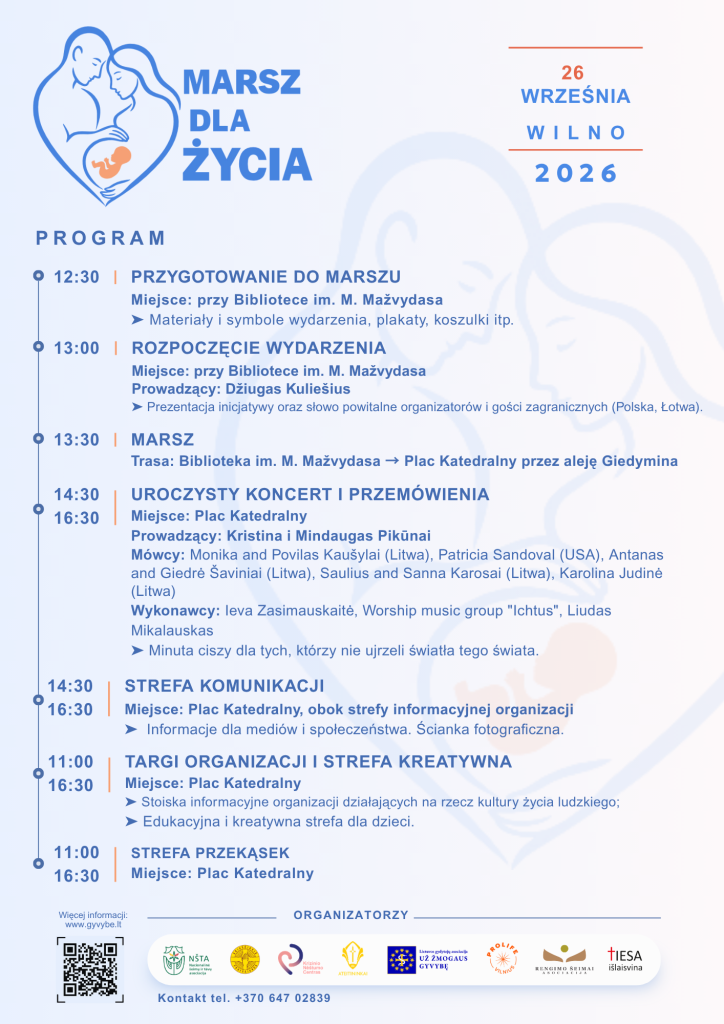
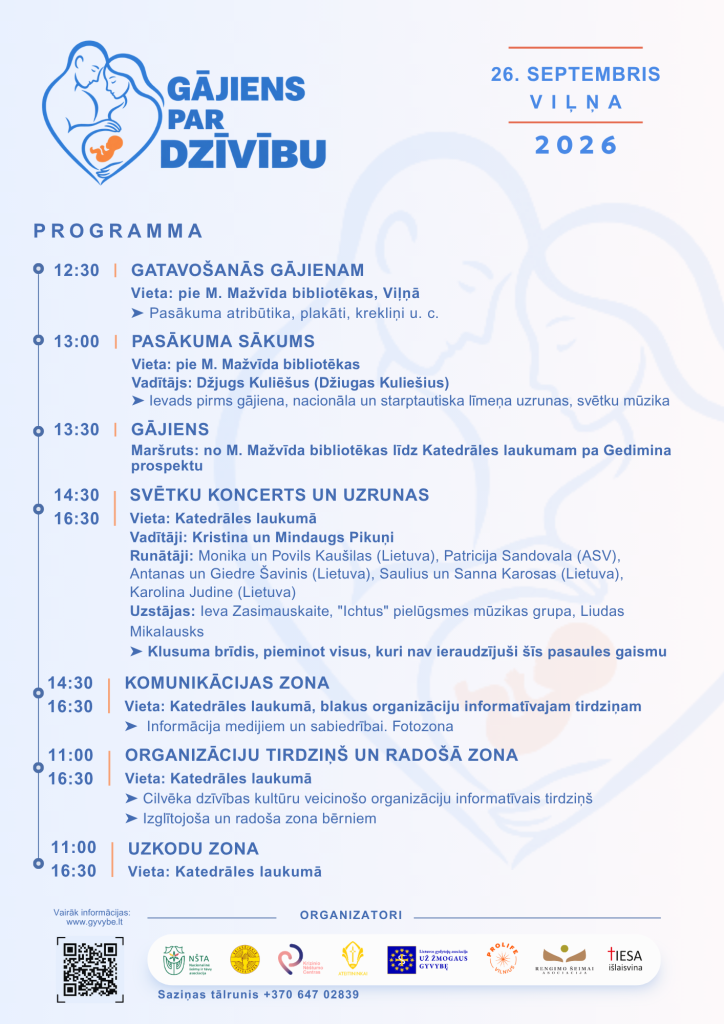
Date: September 26, 2026
Location: Vilnius, Lithuania.
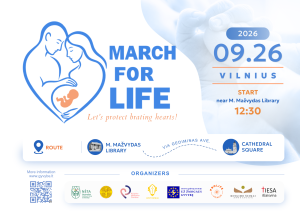
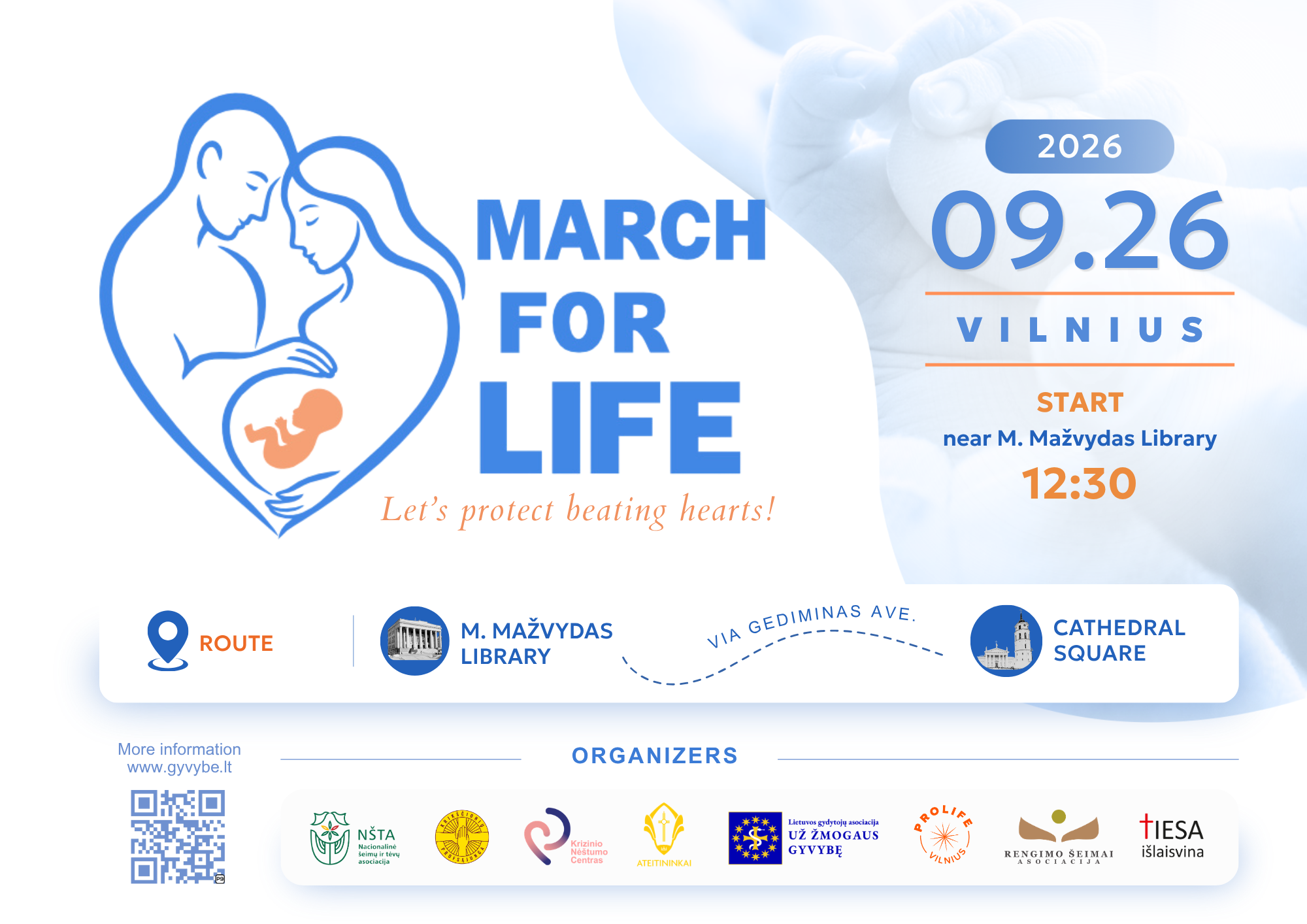
Route: The march begins at the M. Mažvydas Library. We will march along Gedimino Avenue to Cathedral Square.
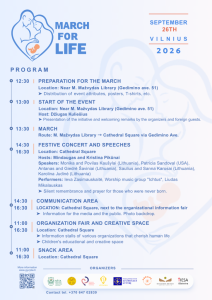
Format: Part I – a peaceful, public, and united march through the center of Vilnius. Everyone gathers at the M. Mažvydas Library, then we will march along Gedimino Avenue to Cathedral Square. Part II of the event will take place at Cathedral Square, featuring a concert, speeches, testimonies followed by a moment of silence for all those who never saw the light of this world, and more.
On September 26th, Vilnius will become the capital of Life – all of Lithuania is invited to the “March for Life 2026”
There are values worth getting off the couch for, putting other things aside, coming together, and speaking out. One of them is human life.
On Saturday, September 26th, 2026, the “March for Life 2026” will take place in the centre of Vilnius – a peaceful event expressing social solidarity and bringing together everyone who cherishes human life from conception to natural death, motherhood, fatherhood, family, and the inherent dignity of every human being.
The organisers hope that people from different cities across Lithuania, as well as guests from abroad, will come together in the capital on this day – families with children, young people, grandparents, communities, healthcare professionals, educators, civic activists, and all people of goodwill who care about the kind of society we are creating for future generations.
This is a day when we want to stand not AGAINST someone, but FOR something – for the human person, for mothers and fathers, for children and families, for those who cannot defend themselves, and for a society in which no one is left alone.
“This march is not a protest against people or their beliefs. Its aim is not to divide, but to unite; not to condemn, but to show that difficult situations in life can be met with help, solidarity, and responsibility. Every life matters, and a strong society begins with caring for those who are most vulnerable,” the organisers emphasise.
The March is more than a walk through the streets of Vilnius
The “March for Life” will begin at 12:30 p.m. outside the Martynas Mažvydas National Library of Lithuania. From there, participants carrying Lithuanian flags and other event symbols will march along Gediminas Avenue to Cathedral Square.
A special programme will await participants in Cathedral Square, including musical performances, testimonies from families, and speeches by representatives from different walks of life and professional fields. A minute of silence will be held in memory of children who never had the opportunity to see the light of this world, while also expressing solidarity with parents who have experienced such a loss.
During the event, there will also be an information fair featuring various organisations, a creative and educational space for children, and other activities promoting community and togetherness.
A culture of life begins with caring for the human person
One of the key messages of the “March for Life” is that fostering a culture of life is inseparable from providing real, practical support to people.
No pregnant woman facing fear, uncertainty, illness, financial difficulties, or other challenges should have to face them alone. Motherhood needs not indifference, but understanding and support.
Yet new life is not solely a woman’s responsibility. The march also highlights the importance of fatherhood – a man’s presence, responsibility, and support for the mother and the growing child. It also recognises the role of grandparents, whose experience, care, and wisdom strengthen young families.
Human life and dignity do not depend on age, health, independence, or social status. Therefore, a culture of life embraces the entire human journey – from conception to natural death: the unborn child and his or her mother, the family, people living with disabilities or serious illnesses, older people, and those who, at the end of their lives, need palliative care, closeness, and respect.
Why is it important to come together?
This year’s march will take place as Lithuania engages in discussions on legislative issues significant to human life and inherent human dignity, including draft laws on Reproductive Health and Assisted Reproduction.
At the same time, the country is facing long-term demographic challenges, including declining birth rates and an ageing population. This raises important questions about what we can and should do to enable families to form and have children with greater confidence, to ensure that motherhood and fatherhood are more highly valued, and that support for families is not merely declared but genuinely provided.
The “March for Life” invites us to speak not only about problems, but also about hope, the future, and our own responsibility. About a Lithuania where families know that they will not be left alone. Where science and medicine first and foremost serve the human person. Where the strength of society is measured by how it treats the smallest, weakest, and most dependent among us.
September 26th – Vilnius, the capital of Life
The voice of one person may sometimes seem quiet. But when families with children, young people, mothers, fathers, grandparents, doctors, teachers, professionals from different fields, and members of communities walk side by side, something greater than a crowd is born – the voice of society.
So mark September 26th on your calendar now. Come with your family. Bring your children. Invite your parents, grandparents, friends, and colleagues. Gather your community or organisation. Bring the Lithuanian flag.
Date: Saturday, September 26th, 2026
Start: 12:30 p.m. outside the Martynas Mažvydas National Library of Lithuania, Vilnius
Route: Along Gediminas Avenue to Cathedral Square
Programme: A peaceful march, concert, speeches by speakers from various fields, family testimonies, a minute of silence, and a community programme featuring a creative and educational space for children, an information fair organised by participating organisations, and more.
Slogan: Let us not stop a beating heart!
Participants: The event is open to everyone, regardless of age, profession, political views, or religious beliefs.
This is more than a march. It is a testimony of unity, hope, and courage.
On September 26th, let us meet in Vilnius and march together – for life!
More information and the event programme: www.gyvybe.lt
ORGANISERS


MEDIA SPONSORS


Hosts
We are delighted to introduce one of this year’s event hosts – Džiugas Kuliešius.
Džiugas became particularly passionate about the culture of life while volunteering with „Pažink save“ (Know Yourself), a programme focused on sexuality education and preparation for family life.
For several years, you could also hear him every day live on XFM Radio, whose motto is “Radio for Life.”
Today, Džiugas is a language editor, event host, radio voice, organiser of intellectual entertainment, and the father of four-year-old Sofija. His energy, insight, engaging communication, and ability to bring people together will be with us at the “March for Life 2026.”
We look forward to welcoming you all on September 26th in Vilnius!
Let’s walk together – for life!

In Cathedral Square, event participants will be welcomed by a wonderful hosting duo – Kristina and Mindaugas Pikūnai.
They are not only event and radio hosts. First and foremost, they are spouses and parents, living every day the very realities we will be talking about at the “March for Life”: family, relationships, responsibility, love, and being there for one another.
Kristina and Mindaugas are the founders of the “Kartu Saldu” Family Centre, relationship and values coaches, and hosts of XFM radio programmes about marriage and family life. In their work, they accompany couples and families, talk about building strong relationships, and encourage people not to forget that a strong family cannot be taken for granted – it is something we build every day.

Speakers
Aistis Stalaučinskas, a speaker at the “March for Life 2026” and chairman of one of the organisations co-organising the event – the Ateitininkai Federation.
Aistis is a father, architect, researcher of nature and history, and today also the leader of one of the oldest Catholic youth organisations in Lithuania. For more than a century, Ateitininkai has brought young people together, encouraging them to grow in faith, responsibility, and love for family, their homeland, and every human person.
On September 26th, Aistis will address those gathered outside the M. Mažvydas National Library and march alongside us – for human life, for the family, and for the younger generation.
Values remain alive when we believe in them and have the courage to stand up for them.

Violeta Vasiliauskienė – a speaker at the “March for Life 2026” and one of the event’s co-organisers.
Violeta is a mother of three, Chairwoman of the National Association of Families and Parents, an international law expert, and lecturer. Through her professional and civic work, she consistently raises issues related to family, fatherhood, motherhood, human dignity, and the fostering of a culture of life.
On September 26th, Violeta will address those gathered outside the M. Mažvydas National Library and march alongside us.
For life. For the family. For motherhood and fatherhood. For a society that refuses to remain indifferent and courageously chooses to foster a culture of life.

Coming from Latvia to the “March for Life 2026” – Agnese Irbe!
Agnese Irbe is a mother of three, philosopher, classical philologist, and Doctor of Philology. She is the editor-in-chief of the Latvian intellectual journal “TELOS” and actively participates in public discussions on human dignity, family, demographics, and the values that form the foundations of society.
Agnese is also the author of the book “A Principled Defense of Human Life”. The issue of human life is an important part of her philosophical and ethical reflections.
Respect for human life knows no national borders, and the conversation about human dignity, responsibility, and the future matters to all of us.

Monika and Povilas are parents of a large family, ambassadors for the Crisis Pregnancy Center, and advocates for family-based parenting. They moved from Vilnius to the countryside so they could raise their children in a peaceful environment.
Monika and Povilas have chosen to educate their children within the family, and when speaking about parenthood, they emphasize daily choices, responsibility, and passing on values to their children.
On September 26, Monika and Povilas will share their family’s experience at the “March for Life 2026.” Their testimony will remind us of a simple truth—a culture of life begins in the family: with love, respect, acceptance, responsibility, and a commitment to be there for one another.


At the “March for Life 2026,” Sanna and Saulius Karosai will share their family’s story—about unexpected trials in life, the choice to accept, love, and how our perspective on a person changes when life leads us down a path different from the one we had planned.
Saulius’s message about the value of human life, acceptance, and compassion stems not only from his ministry as pastor of the City Church but also from his family’s deeply personal experience. After the birth of their daughter with Down syndrome, the family later decided to adopt a boy who also has the syndrome. Their journey as parents and as a family is marked by challenges, but also by love, gratitude, and a deep sense of meaning.
On September 26, Sanna and Saulius will share their experiences and speak about life, whose value does not depend on a person’s health, abilities, or life circumstances. Let’s meet and hear their family’s testimony firsthand.


Information is periodically updated and supplemented.